Understanding what types of EV charging stations are available in China begins with a simple observation: drivers do not charge in one setting. A private AC charger may sit beside an apartment parking space overnight. A public DC charger may add hundreds of kilometres during a highway rest stop. Destination chargers appear near offices, shopping centres, hotels, and residential compounds. Battery-swapping stations offer another route, especially for selected vehicles and commercial fleets. The equipment looks different, but the user’s need remains practical: safe, compatible, and predictable energy.
Zhang Yongwei, vice chairman and secretary-general of China EV100, has stressed, “Charging infrastructure must follow real travel needs, not merely vehicle sales.” That principle helps explain China’s mixed network. AC chargers usually deliver slower, gentler charging. DC fast chargers reduce waiting time but require stronger grid connections and careful thermal management. Ultra-fast units can be useful on busy corridors, though not every vehicle can accept their highest output. China’s GB/T charging standards also influence plug compatibility, payment systems, and station design.
The categories are useful, but they can oversimplify reality. A fast charger may slow down when several cars share one cabinet. A residential station may be unavailable because another vehicle is parked there. Weather, queues, pricing, and local electricity capacity also matter. Therefore, this guide examines the main station types across China, their charging speeds, typical locations, technical limits, and everyday advantages. Readers will gain a clearer basis for choosing equipment, planning routes, or evaluating an installation. The answer is not only about speed. It is about fit.
China classifies EV charging stations by both access and charging method. Public stations serve any eligible driver, while private stations are installed at homes or residential parking spaces. Dedicated stations support buses, taxis, logistics fleets, or government vehicles. The categories can overlap. A depot charger may be private in access but commercial in operation.
The second classification concerns electricity delivery. AC chargers usually provide slower overnight charging, often around 7–22 kW. DC chargers convert power outside the vehicle and support faster charging, commonly from 30 kW upward. High-power units can exceed 250 kW, but vehicle limits, battery temperature, and grid capacity affect actual speed. China’s national charging standards also distinguish charging interfaces, communication, and safety requirements. These technical labels matter more than marketing terms.
According to the China Electric Vehicle Charging Infrastructure Promotion Alliance, China had about 3.58 million public charging facilities by the end of 2024. The International Energy Agency reported that China held the world’s largest public charging network in 2023. Still, national totals hide uneven regional access. Urban districts may offer dense DC coverage, while rural highways can remain inconvenient.
Tips: Check whether a station is public, dedicated, or private before planning a trip. Confirm connector compatibility, rated power, payment access, and parking rules. A higher power rating does not guarantee faster charging. That assumption deserves reconsideration.
China’s EV charging network includes AC and DC stations, but AC charging remains practical for homes, workplaces, and public parking. AC units deliver electricity gradually through the vehicle’s onboard charger. This makes them suitable for overnight or long-stay charging.
Home users often choose compact AC chargers rated around 7 kilowatts. A typical installation needs a household load assessment, dedicated wiring, residual-current protection, and weather-resistant equipment. The charging point should sit near the parking space, not across a walkway. Small details matter.
At workplaces, 11-kilowatt or 22-kilowatt AC stations can serve vehicles parked for several hours. Property managers should review peak electricity demand before adding multiple units. Otherwise, several cars may charge at once and strain the building’s supply. Public parking areas need clear signs, cable management, lighting, and reliable payment access. China commonly uses national-standard charging interfaces, but compatibility should still be checked before installation. A higher power rating is not always better. Many vehicles cannot accept the full output, so extra capacity may add cost without reducing charging time. That assumption needs checking. Regular inspections can identify loose connectors, damaged cables, water exposure, or overheating early. In practice, charging speed depends on the vehicle, battery condition, parking duration, and site capacity. Convenience is valuable, but safe installation and honest performance information matter more.
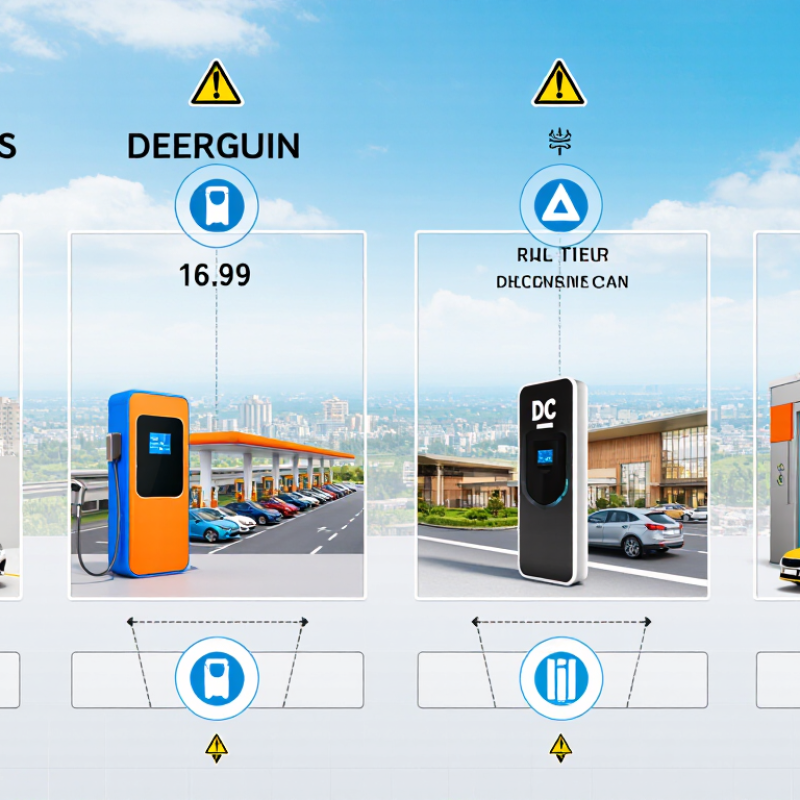
DC fast-charging stations are reshaping long-distance EV travel in China. They commonly deliver 30–350 kW, although real output depends on battery temperature, charge level, and grid capacity. The International Energy Agency’s Global EV Outlook 2024 reported that China held about 60% of the world’s public charging points in 2023. It also hosted roughly 85% of global public fast chargers. These figures show impressive scale, but speed is contextual. A 15-minute stop may add substantial range, yet the final charging percentage usually slows sharply.
In practical use, drivers may find fast chargers beside highways, parking areas, and urban transport hubs. A clear screen, short cable reach, and protected waiting area matter more than impressive power ratings. The China Electric Vehicle Charging Infrastructure Promotion Alliance also tracks rapid growth in public charging equipment, supporting wider access across cities and expressways. Still, local congestion and uneven maintenance remain realistic concerns. More chargers do not always mean a smoother experience.
Tips: Arrive with a warm battery when possible. Leave before 100% unless necessary. Check charging power during the first minute. Keep a backup location nearby. Small habits help. Data reports describe infrastructure growth, but drivers should judge reliability through repeated, real-world use.
| Charging Station Type | Typical Rated Power | Typical DC Output Voltage | Typical DC Output Current | Approximate Charging Time | Common Locations | Typical Use Case |
|---|---|---|---|---|---|---|
| Urban DC Fast Charger | 20–60 kW | 200–750 V | 50–150 A | Approximately 30–90 minutes for a substantial charge, depending on the vehicle and battery state | Public parking areas, shopping centers, office districts, and residential parking facilities | Convenient top-up charging during daily travel and short stops |
| High-Power Public DC Charger | 60–180 kW | 200–950 V | 100–250 A | Approximately 20–45 minutes for a substantial charge when the vehicle supports the available power | Urban charging hubs, transport centers, commercial parking facilities, and major roads | Faster public charging for passenger cars, taxis, and ride-hailing vehicles |
| Highway DC Fast Charger | 120–250 kW | 200–950 V | 200–350 A | Approximately 15–40 minutes for a substantial charge under suitable conditions | Expressway service areas and intercity travel corridors | Reducing charging stops during long-distance travel |
| Ultra-High-Power DC Charger | 250–480+ kW | 500–1,000 V | 300–600+ A | Potentially about 10–30 minutes for a substantial charge on compatible vehicles | Selected high-demand charging hubs and advanced highway facilities | Very rapid charging for vehicles designed for high-voltage and high-current input |
| Split-Power or Shared DC Charger | 60–240 kW total cabinet capacity | 200–950 V | Varies by power allocation | Depends on how many vehicles are charging and how power is distributed | Fleet depots, parking structures, charging plazas, and logistics facilities | Serving multiple vehicles while dynamically allocating available power |
| Liquid-Cooled High-Power Charger | 250–600+ kW | 500–1,000 V | Approximately 400–600+ A | Potentially about 10–20 minutes for a substantial charge on compatible vehicles | Heavy-use charging hubs, highway sites, and commercial fleet facilities | Managing high current with reduced cable heating and improved charging ergonomics |
| Dedicated Fleet DC Charger | 30–240 kW per charging point | 200–950 V | Varies according to vehicle requirements | Approximately 30 minutes to several hours, depending on fleet schedules and battery capacity | Bus depots, taxi facilities, logistics parks, and delivery centers | Planned charging for buses, commercial vehicles, taxis, and delivery fleets |
What Types of EV Charging Stations Are Available in China?
Battery-Swapping Stations as an Alternative to Plug-In Charging
China’s EV charging network includes plug-in chargers and battery-swapping stations. Swapping changes the energy supply, not the vehicle’s driving system. A trained machine removes a depleted pack and installs a charged one. The process can take several minutes. That matters for taxis, delivery vans, and drivers without private parking. Speed is the strongest argument. It is not the only one.
In a well-managed station, the driver parks inside a marked bay and follows screen instructions. Sensors check vehicle position, pack identity, temperature, and locking points. Staff or automated equipment then completes the exchange. Charged batteries wait in controlled cabinets, where software tracks their condition. This creates a service-based model. Drivers may pay for energy, access, or both. Yet station coverage remains uneven, and compatible vehicles are essential. A plug-in charger serves more vehicle designs. Swapping depends on shared dimensions, connectors, and safety rules.
Battery swapping can reduce charging queues and limit long stops during busy periods. It may also help apartment residents without reliable parking power. However, the system needs expensive facilities and careful battery management. A damaged pack cannot be treated like ordinary inventory. Operators must inspect it, isolate faults, and follow local safety requirements. The environmental benefit also depends on electricity sources and battery life. For high-use fleets, the case appears stronger. For occasional drivers, it remains less obvious. Convenience comes with dependence on station availability.
China’s public charging infrastructure mainly consists of alternating-current (AC) and direct-current (DC) charging piles. AC chargers are generally suited to longer parking periods, while DC fast chargers are designed for quicker replenishment during travel. Battery-swapping stations provide an alternative by replacing a depleted battery with a charged one instead of connecting the vehicle to a plug-in charger.
Data shown: public charging piles in China as of December 2024. Source: China Electric Vehicle Charging Infrastructure Promotion Alliance.
China’s fleet charging market is built around duty cycles, not one universal plug. Depot chargers support buses and delivery vehicles during overnight parking. They usually combine medium-power AC charging with high-power DC units. This arrangement reduces pressure on the grid during busy daytime hours.
Urban buses often need opportunity charging at terminals. Pantograph systems can add energy during short route breaks. Taxi charging hubs require higher turnover and simple payment processes. Drivers may have only 20 minutes between shifts. Reliable cooling, cable handling, and clear parking guidance become practical priorities.
China’s public charging network reached about 3.58 million units by the end of 2024, according to the China Electric Vehicle Charging Infrastructure Promotion Alliance. However, the total number alone says little about fleet usefulness. Location, uptime, and queuing time matter more.
Commercial fleets need smarter management. Fleet operators can schedule charging around routes, battery levels, and electricity prices. High-power DC charging helps long-distance vehicles, but it can increase equipment costs and local grid demand.
The International Energy Agency reported that China held over half of the world’s public charging stock in 2023. That scale supports rapid deployment, yet maintenance remains uneven in some locations.
A charger may be technically available but operationally unusable. This is an uncomfortable gap. Future planning should measure successful charging sessions, not just installed equipment.
They are classified by access and charging method. Public stations serve eligible drivers. Private stations serve homes or residential parking. Dedicated stations support fleets or government vehicles. Categories can overlap.
AC charging is usually slower and suits overnight parking. Common ratings range from 7 to 22 kW. DC chargers convert electricity outside the vehicle and charge faster. Their output commonly starts around 30 kW.
AC chargers work well at homes, workplaces, and long-stay parking areas. A home unit may provide about 7 kW. Workplace chargers can use 11 or 22 kW. Charging takes longer, but parking time helps.
Check household load capacity, dedicated wiring, and residual-current protection. Use weather-resistant equipment. Place the charger beside the parking space. Do not run cables across a walkway. Small details protect people.
No. Vehicle limits, battery temperature, charge level, and grid capacity affect speed. A vehicle may accept only part of the advertised output. Extra capacity can increase cost without saving time. I might overestimate speed by reading the sign alone.
DC chargers can support rapid travel, especially near highways and transport hubs. Charging often slows near full capacity. A short stop may add useful range. The last few percentages usually take longer.
Urban districts may have dense fast-charging coverage. Rural highways can offer fewer convenient locations. Busy sites may still have queues or maintenance problems. More chargers do not always mean a smoother trip.
Confirm public or dedicated access, connector compatibility, rated power, payment access, and parking rules. Watch the charging screen during the first minute. Keep a backup location nearby. Plans can fail.
Inspect connectors, cables, lighting, and payment systems regularly. Look for loose plugs, water exposure, damaged insulation, or overheating. Protected waiting areas also improve usability. Reliability needs repeated real-world checking.
China offers several types of EV charging stations designed for different vehicles, locations, and charging needs. When asking “what types of EV charging stations are available,” the main categories include AC charging stations, DC fast-charging stations, battery-swapping stations, and specialized facilities for commercial fleets. AC chargers are commonly installed at homes, workplaces, residential areas, and public parking lots, making them suitable for overnight or longer-duration charging.
DC fast-charging stations provide higher power and are intended for drivers who need to recharge quickly during long journeys or busy daily schedules. Battery-swapping stations offer another solution by replacing a depleted battery with a charged one, reducing waiting time where compatible systems are available. In addition, dedicated charging stations support buses, taxis, delivery vehicles, and other commercial fleets, often with layouts and power levels adapted to frequent use. Together, these options form a diverse charging network that supports private drivers, public transportation, and commercial mobility across China.

SHE Auto